Reimplementation
Give us a CVRP paper. We read it, write the method from its text alone, run it under one protocol, and tell you whether the numbers it published come back.
There is no standing check that a published CVRP heuristic reproduces. This runs one from the paper, records every decision it had to make, and hands you the code and the solution files so you can check the answer yourself.
Capacitated vehicle routing only. A paper with no CVRP component in it is refused at the first stage.
Sign in to submit a paper Why there is no ranking
Two ways to run it
On your own machine, on your own subscription
Download it and run it yourself, on a Claude subscription. Your paper is never uploaded here; it goes to Anthropic and nowhere else. The runner has the same pages as this site, and you can send the finished work back when you choose.
Or let us run it
Paste an API key and we run it on our machine; you supply only the paper. The timed runs that reproduce your paper's numbers come back to you as a bundle.
What it does
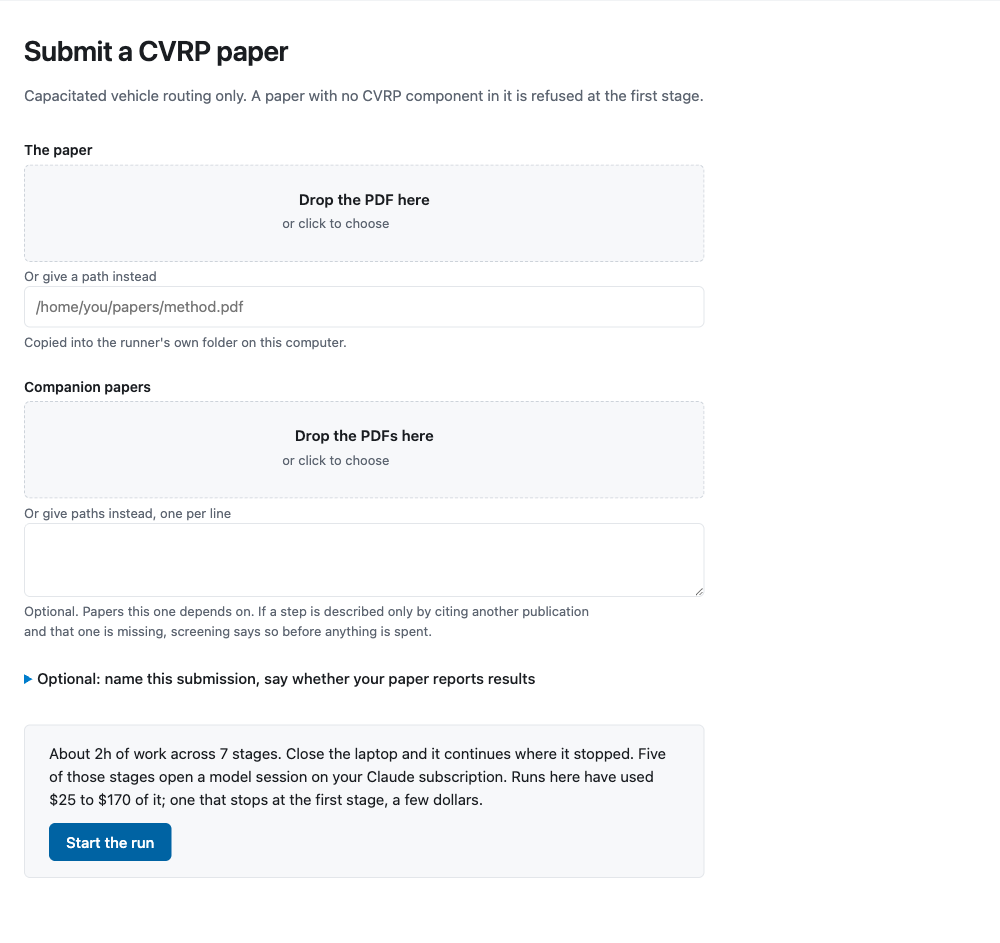
It asks for the paper, for any earlier paper the method leans on, and for nothing else. What a run will use is stated above the button that starts it.
An example: two papers, faced off
Two papers can be submitted together. Each is reimplemented on its own from its own text, judged against its own published values, then compared under one protocol: same language, same core, same implementer, same instances, same seeds, same budget, same machine. Neither run sees the other.

D-Ants (Reimann, Doerner and Hartl 2004) against the improved petal method (Renaud, Boctor and Laporte 1996), over 114 of the 134 instances both papers can be compared on: a mean gap to best-known of 1.00 per cent against 10.81 per cent. Read it with this in front of you: the 1996 paper did NOT reproduce its own published values, and our page says so in the header of its own column. The 2004 paper did.
What that establishes is narrower than a winner: it does not say one method is better. Both were implemented by the same person on the same machine, so the difference is not in who wrote the code, it is in how completely each paper described its method, and the better-described one is easier to implement well. It says nothing about either method in the hands of its own author.
The downloadable version, in more detail
Seven stages, the same ones we run here, driven from a small web page on your own computer. It waits when your usage window closes and picks up where it stopped, so a long paper spread over two days costs you nothing more than time.
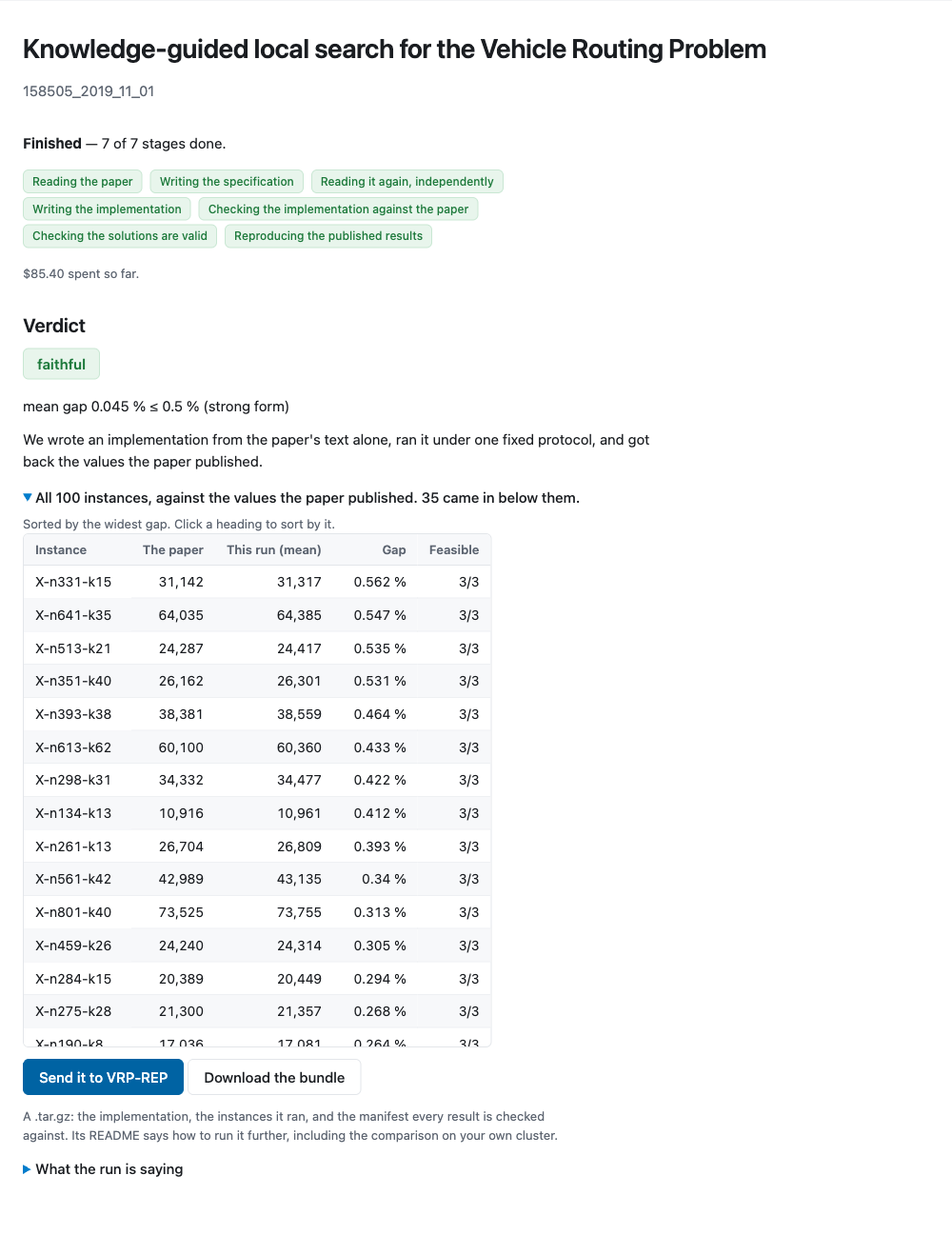
The end of a run: the verdict with the figure that earned it, then every instance against what the paper published.
Version 1.100.0, 3.3 MB. Sign in to download it.
What has been through it
Nothing yet on this server. The corpus this was built and calibrated against is thirteen published methods, reimplemented and reproduced before the submission path opened.
What it costs you
Nothing to us. On your own machine it spends five model sessions of a Claude subscription across seven stages. That subscription is the only thing this costs: about $20 a month from Anthropic. If you keep one for other work it covers this too; if you do not, you will need one before you start.
If you would rather we ran it: of the twenty-seven runs this was calibrated on, about half stopped in the first few minutes for two to five dollars, and one that gets past that has cost twenty to a hundred and seventy-five on your own key, the middle one fifty-three, billed by Anthropic. At a hundred and fifty we stop and ask before spending more. VRP-REP never holds a balance or sees your invoice.